— April 27, 2026 —
But, how do the claims hold up against the science?
In a recent interview with CBC News, Stefanie Colombo, Canada Research Chair in Aquaculture and Nutrition at Dalhousie University, takes a closer look at the facts. From omega-3 content and protein levels to contaminants and fish health, she addresses some of the most common misconceptions about farmed salmon with clear, evidence-based insights.
Below, we’re sharing the full interview (originally published by CBC News on April 26, 2026), which offers a grounded, science-first perspective on an issue that continues to shape public conversation around seafood, sustainability, and food choices.
Vernon Ramesar · CBC News · Posted: Apr 26, 2026 6:00 AM ADT | Last Updated: April 26
A campaign called Off the Table is encouraging people in the hospitality industry to take farmed salmon off their menus.
The U.K.-based charity WildFish created the global campaign. Its Canadian partners are Living Oceans and the Atlantic Salmon Federation.
WildFish says on its website and in social media advertisements that farmed salmon is bad for the planet, bad for people and bad for wild salmon. A number of Nova Scotia restaurants have signed on.
Stefanie Colombo, Canada research chair of aquaculture and nutrition at Dalhousie University, spoke to CBC Radio’s Mainstreet Nova Scotia about claims made by the campaign.
This interview has been edited for clarity and length.
The campaign says that farmed salmon has more omega-6 fatty acids and less omega-3 fatty acids. Is that, in fact, the case?
The statement that farmed salmon has more omega-6 than omega-3 is not true.
We’ve done several studies, two of which are published and openly available, on the omega-3 content and nutritional content of various types of salmon. That would include both farmed and wild and different types of species that you can buy at the grocery store. And in fact, it’s not. The omega-3 content in farmed Atlantic salmon is not different compared to other types of wild salmon.
It’s really about the species of salmon that makes the difference in the omega-3 content.
Farmed Atlantic is similar to farmed Chinook, which is similar to wild Chinook. Wild Pacific has significantly lower omega-3 content than a wild sockeye or farmed salmon.
The campaign says that the colour of the salmon is from an additive the fish are fed. Is that something people should be concerned about?
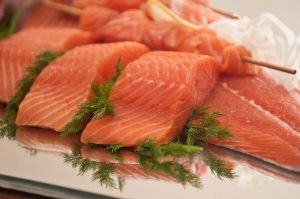
No. I have seen that campaign and I wanted to dispel a myth that the salmon would be grey. They do require a source of that pigment in their diet, just like salmon in the wild do. The molecule is called astaxanthin, it’s a type of pigment, also known as a carotenoid, and wild salmon get this in their diet. That is why wild salmon are the colour that they are.
It’s also the same compound that makes flamingos pink and shrimp and lobsters red.
That is not something to be of concern to any consumers.
Astaxanthin itself is a very potent antioxidant. It’s actually has 100 times the antioxidant capacity as vitamin E. So it’s a very helpful compound.

Is there a scientifically significant difference in protein levels between wild and farmed fish?
No, not at all.
I’ll go back to the studies that we’ve published. Other labs such as in Norway and Scotland have also published with similar findings, including that the protein level does not depend on whether it’s wild or farmed. It depends on the species of salmon.
It’s not whether it was farmed or wild, it’s based on the different types of salmon that you can buy at the grocery store.
The campaign mentions PCBs and cancer risks. How concerned should Nova Scotians be about the levels of contaminants found in Atlantic farmed salmon compared to let’s say 10 or 20 years ago?
Because the diet of farmed salmon has changed so much, it is not a concern at all. It really wasn’t even a concern 20-30 years ago anyway.
The contaminant levels — this would include PCBs, dioxin, and mercury— are dramatically lower in farmed salmon compared to wild salmon simply based on the diet and where they live.
In a farmed environment, the diet is strictly controlled.
It used to be mostly based on wild-sourced fish. So, this would be fishmeal and fish oil from anchovies, sardines, menhaden. But now that’s shifted to incorporating ingredients that are more plant-based, even things like microalgae.
These contaminants are not in these ingredients. But wild salmon are still unfortunately exposed to these much as the other wild seafood that we eat.
Nova Scotians should have zero concern about consuming farmed or wild salmon in their diet in terms of contaminant levels.
Off the Table uses the term ‘factory product’ to describe farmed salmon. Does the fact that farmed fish consume a controlled diet necessarily make them lesser than a wild fish that eats in the open ocean?
Absolutely not.
I find that term factory to be very strange considering we live in a world of modern agriculture. However, I think that’s a huge benefit actually of consuming an animal and honestly, whether that be salmon or a cow or a chicken, to know exactly what food it was eating, exactly the environment that it was living in.
And in Canada, we have very strict regulations about what products those farm fish can consume.